

Joel Greenblatt was born on 13 December 1957 in Great Neck, a suburb on the north shore of Long Island, New York, and he has spent almost the whole of his working life a few miles away in Manhattan. He went to the Wharton School at the University of Pennsylvania on a five-year programme that gave him a bachelor's degree in 1979 and an MBA in 1980, although the teaching did little to persuade him. "I went to Wharton, and, as they still do today, they taught the efficient market theory," says Mr Greenblatt, who has since described himself as self-taught, because his understanding of the stock market came from reading.
What he read, while still a student, was Benjamin Graham, and he set about testing Graham's idea of purchasing shares for less than the value of their net current assets with two fellow students, Richard Pzena and Bruce Newberg. Their paper, "How the small investor can beat the market", appeared in the Journal of Portfolio Management in 1981, and it found that such shares had beaten the market by a wide margin between 1972 and 1978, and by a wider one still when a low price-to-earnings ratio was added as a second test. It was the first appearance of a habit that ran through his career, which was to take a sensible-sounding idea and check whether it had worked.
However, he did not go straight into investing. He spent a year at law school, at Stanford according to most accounts, before deciding that it was not for him, and he then worked as an analyst at a small risk-arbitrage firm, which later profiles name as Halcyon Investments. Risk arbitrage means purchasing shares in a company that has agreed to be taken over and collecting the gap between the market price and the offer, and Joel Greenblatt has said that he never cared for a trade in which the gain was small if the deal completed and the loss large if it did not, so that the experience pushed him towards spin-offs and restructurings, where the odds looked better.

Gotham Capital opened in 1985, when Joel Greenblatt was 27, with around $7m, most of it from Michael Milken, the Drexel Burnham Lambert financier whose high-yield bond operation was then at the height of its influence and who pleaded guilty to securities violations five years later. Contemporary reporting described Joel Greenblatt as having "got his seed capital from Michael Milken", and he has since described the negotiation over terms as a tough one. Robert Goldstein joined Gotham Capital in 1989, and the two of them have worked together ever since.
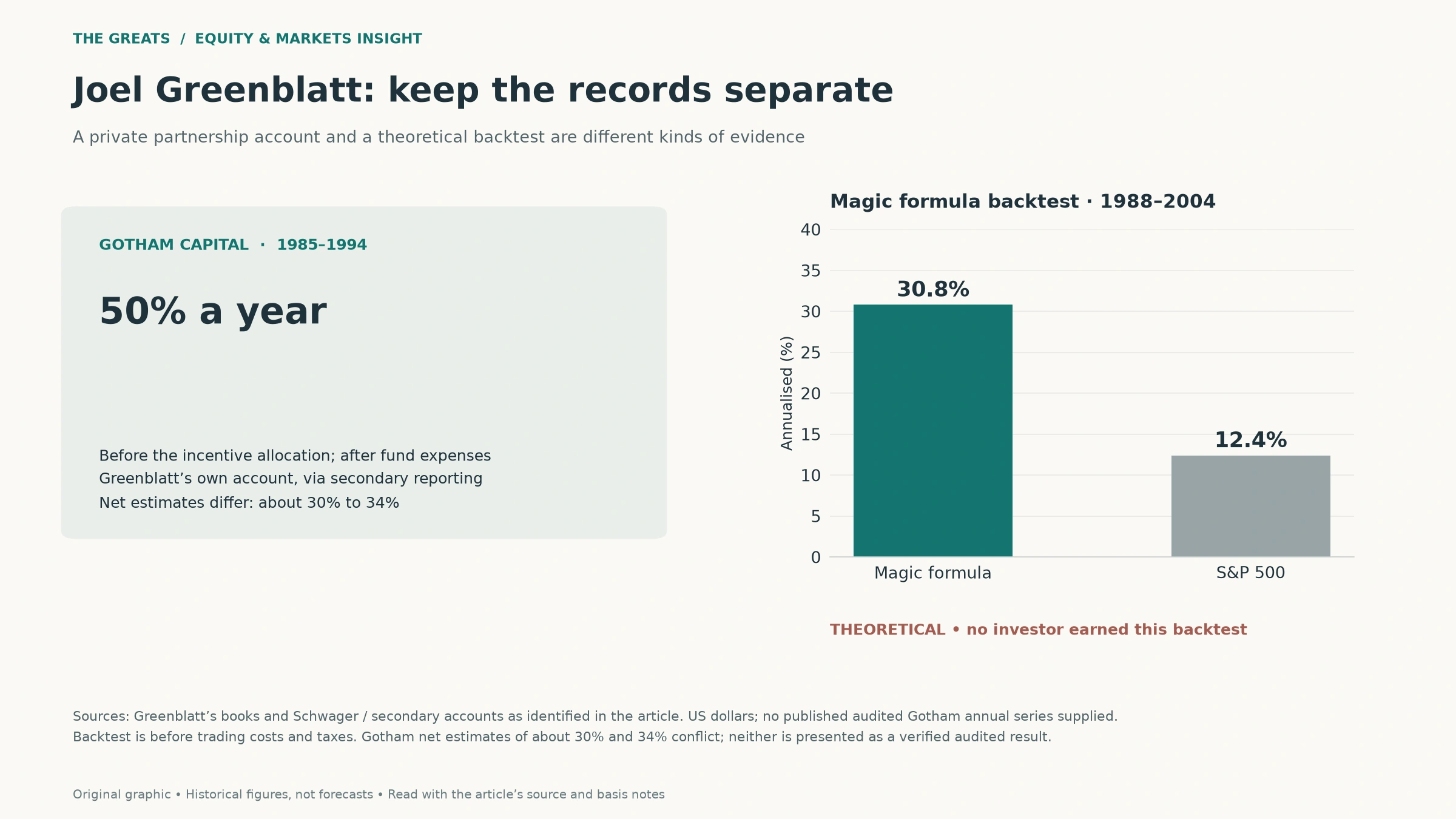
The record of the next ten years is the one on which Joel Greenblatt's reputation rests, and it needs to be read carefully. It appears in the appendix to his first book, and as Jack Schwager set it out after interviewing him, "the average annualized compounded return was exactly 50.0 percent (before incentive fees)" from 1985 to 1994, with the worst year a gain of 28.5%. Putting this another way, the figure is after the fund's expenses but before the general partner took his share of the profits, and it is Joel Greenblatt's own account rather than an audited series published in full. After the incentive allocation the outside investors received around 34% a year according to one later account and around 30% according to others, which is still one of the best ten-year records in investing, although it was earned on a small pool of money in a period when American shares did well, and it is not a forecast.
The returns came from a portfolio that most fund managers would regard as reckless. "During a lot of my career, six or eight positions represented 80+% of my portfolio," says Mr Greenblatt, and the price of that concentration was paid in the short term. "Every two or three years we could lose 20-30% of our net worth over a very short period of time," he said in 2014. "That's what happens when you run a concentrated book." The positions were the special situations he had learned to look for, meaning spin-offs, restructurings, rights offerings and merger securities, where the shares were being sold by investors who had never chosen to own them and did not want to find out what they were worth.
The best-known example is Marriott, which on 8 October 1993 split itself in two, so that a new company called Marriott International took the hotel management and franchising business, which needed little capital and earned steady fees, whereas the old company, renamed Host Marriott, kept the hotel properties, the airport and toll-road concessions and most of the debt. Stephen Bollenbach, the finance director who designed the deal, became chief executive of Host Marriott, and the Marriott family kept around a quarter of both companies. Host Marriott shares traded at around $5 while carrying roughly $25 of debt a share, so that a modest rise in the value of the hotels would produce a very large rise in the value of the equity.
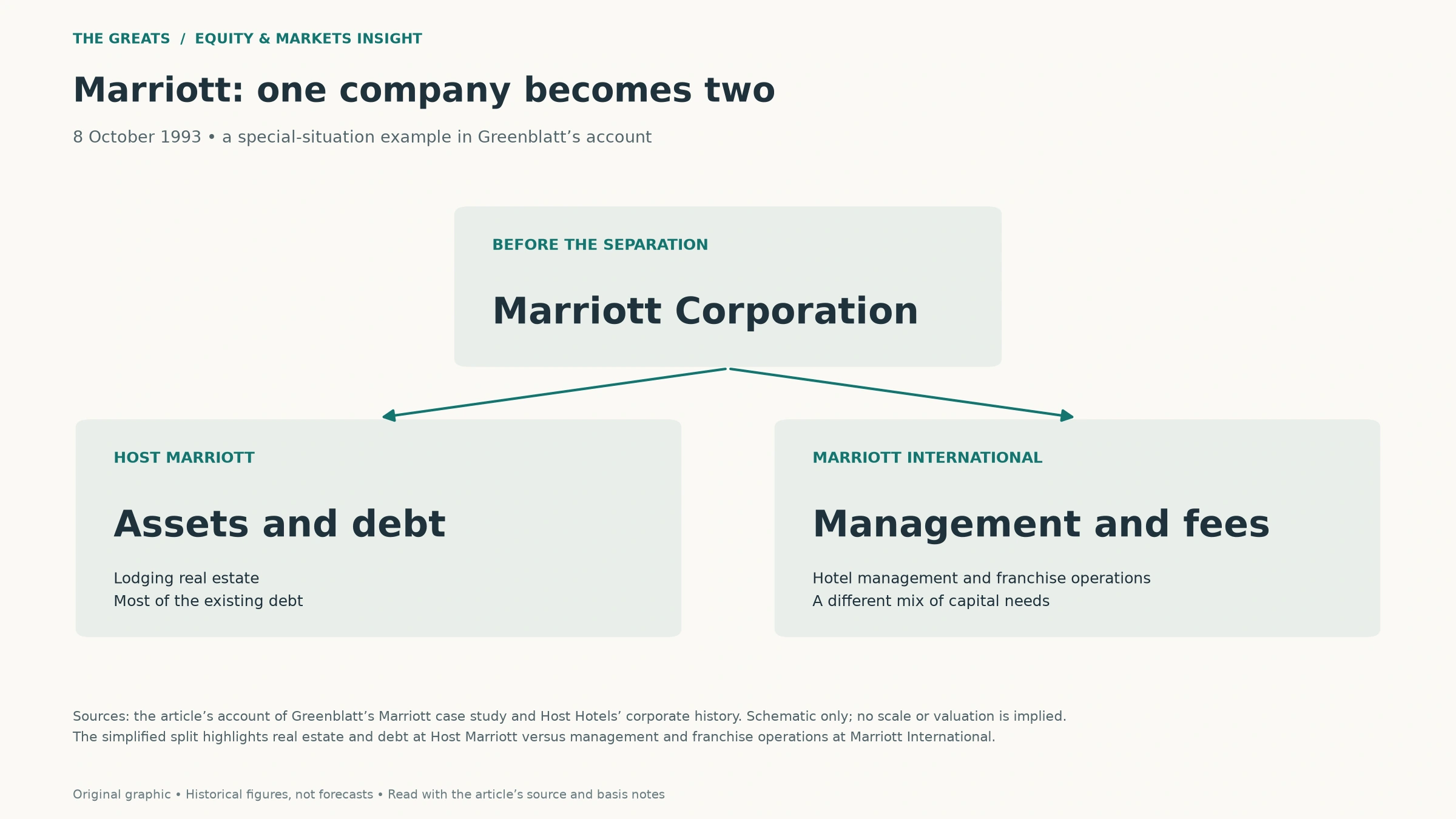
Most institutions that received Host Marriott shares sold them, because the company was small, indebted and unglamorous, and the price fell in the first days of trading. However, Joel Greenblatt reasoned that the people who knew most about the business had chosen to keep large stakes in it, and that the debt which frightened everyone else was exactly what would make the shares valuable if the hotel market recovered even a little. He purchased the shares, and by his own account they roughly tripled within a few months, although the same arithmetic works in reverse, so that a fall in asset values would have wiped out the equity just as quickly.
"We ran outside capital at Gotham Capital for ten years and then returned the outside capital in '94," says Mr Greenblatt, and the money went back to the outside partners in January 1995, by which time it was reported to amount to around $500m. He carried on running his own and his partners' capital in the same way for another decade, having decided that he was rich enough and that a much larger fund would earn less.
The next stage of his career was teaching. "I also started teaching at Columbia in '96," says Mr Greenblatt, and he taught Value and Special Situation Investing at Columbia Business School, as an adjunct professor, for more than two decades. His first book, "You Can Be a Stock Market Genius", followed in 1997 as a working manual for the trades that made Gotham Capital's record, with the Marriott case among its examples and the Gotham figures in the appendix, and in 1999 he and John Petry, a colleague at Gotham Capital, founded the Value Investors Club, a website on which a membership capped at 250 investors post detailed investment ideas.

The idea for which he is best known came out of research rather than a trade. "Around 2003, my partner, Rob Goldstein, and I decided to do some research on our own strategies," says Mr Greenblatt, and the question was whether a good business at a cheap price could be found by a mechanical ranking. They took the 3,500 largest American companies, excluding utilities and financials, ranked each one by earnings yield, meaning operating profit divided by enterprise value, and separately by return on capital, meaning operating profit divided by net working capital plus net fixed assets, and added the two ranks together. A portfolio of the 30 best-ranked shares, held for a year and replaced, would have returned 30.8% a year between 1988 and 2004, against 12.4% for the S&P 500. "My write-up of the results of our very first test formed the basis for The Little Book That Beats the Market," says Mr Greenblatt, and the book was published in 2005.
He called the ranking the magic formula, and the name has not helped, because the figures are a backtest, before trading costs and taxes, which no investor experienced. Joel Greenblatt was unusually frank about this in the book. "The magic formula portfolio fared poorly relative to the market average in 5 out of every 12 months tested," he wrote, and "for full-year periods, the magic formula failed to beat the market averages once every four years", with some stretches of two and three years in which it lagged. His argument was that this was precisely why it might go on working, because most investors would give up during the bad patches, and he added that "if everyone used the formula, the bargains would disappear and the magic formula would be ruined." When the book was reissued in 2010 with the test extended through 2009, the reported advantage had narrowed to around 24% a year, a figure that comes from secondary summaries of the new edition.
The research also changed how Joel Greenblatt invested. In 2009 he launched Formula Investing, an online service running accounts along magic-formula lines, and in October 2010 Gotham Asset Management, the successor to Gotham Capital that he and Robert Goldstein had formed, began taking institutional money into long-short funds. The first mutual fund, the Gotham Absolute Return Fund, followed on 31 August 2012, and these portfolios hold hundreds of shares long and hundreds short, ranked by the firm's own valuations, so that by October 2014 the mutual funds alone had gathered $4.78bn. "The approach now is probably the better strategy for most people," says Mr Greenblatt, as "the ups and downs should be much less severe".
However, the later funds have their own records, which are not a continuation of the Gotham Capital record, because they are diversified where the old partnership was concentrated, they carry mutual-fund expenses rather than an incentive allocation, and their returns since 2012 have generally been within a few percentage points of the market rather than multiples of it. Gotham Asset Management's regulatory filing for 31 March 2026 showed American long positions worth $32.7bn across 1,749 holdings, although that figure measures the long book of leveraged long-short funds rather than assets under management, and assets are not performance in any case.
Away from the markets, Joel Greenblatt's money has gone into schools, beginning with $2.5m for P.S. 65, a state primary school in Queens, in 2002, and in 2006 he and John Petry founded the Harlem Success Academy, a charter school that opened with 157 children chosen by lottery. "My business partner John Petry and I hired a woman, Eva Moskowitz," says Mr Greenblatt, and under her the network, renamed Success Academy Charter Schools, had grown to 46 schools and some 20,000 pupils by 2020, the year in which his fourth book, "Common Sense", argued for charter schools and other reforms from the perspective of a long-term investor.
Joel Greenblatt is 68 and remains managing principal and co-chief investment officer of Gotham Asset Management alongside Robert Goldstein. His record divides into a ten-year partnership that compounded at 50% a year before fees on a handful of positions and a much larger firm that has aimed for steadier results across hundreds of them, and he has been clearer than most managers that the first was not a reasonable thing to expect of the second. "If I can't wait around for a year or two for the market to get it right," says Mr Greenblatt, "I shouldn't be in stocks in the first place."
The record
| Period | Figure | Basis |
|---|---|---|
| Gotham Capital, 1985–1994 | 50.0% a year, compounded | Before the general partner's incentive allocation, after fund expenses; from the appendix to "You Can Be a Stock Market Genius" as reported by Jack Schwager. Worst year a gain of 28.5%. |
| Gotham Capital, 1985–1994, net to outside partners | c.34% a year (one account); c.30% (others) | After the incentive allocation; secondary accounts, not a published audited series |
| Magic formula backtest, 1988–2004 | 30.8% a year | Top 30 of the 3,500 largest US companies by combined earnings-yield and return-on-capital rank, held one year, before trading costs and taxes; from "The Little Book That Beats the Market" |
| S&P 500, 1988–2004 | 12.4% a year | Same period, as stated in the book |
| Magic formula backtest, 1988–2009 | c.24% a year | Extended test in the 2010 edition; figure from secondary summaries only |
| Gotham Funds mutual-fund assets, October 2014 | $4.78bn | Assets gathered since August 2012, from The Hedge Fund Journal; an asset figure, not a return |
| Gotham Asset Management 13F long positions, 31 March 2026 | $32.7bn, 1,749 holdings | SEC Form 13F; long US positions only, not assets under management |
The Gotham Capital figures are Joel Greenblatt's own account of a private partnership, in US dollars, before the general partner's share of profits, and they cover ten years on a small and highly concentrated pool of capital. The magic formula figures are a backtest, meaning a calculation of what a rule would have produced had it been followed, and no investor earned them. None of the figures is the record of the Gotham mutual funds, which began in 2012 and have their own published returns and expenses, and none of them is a forecast.
Life in dates
- 1957Born in Great Neck, New York, on 13 December.
- 1979Graduates from the Wharton School with a BS, summa cum laude; completes his MBA there in 1980.
- 1981Publishes "How the small investor can beat the market" with Richard Pzena and Bruce Newberg in the Journal of Portfolio Management. Spends a year at law school before leaving for a job in risk arbitrage.
- 1985Founds Gotham Capital with around $7m, most of it from Michael Milken.
- 1989Robert Goldstein joins Gotham Capital.
- 1993Marriott Corporation splits on 8 October; Gotham Capital purchases Host Marriott.
- 1994Ends the ten-year outside-capital record; chairman of Alliant Techsystems, 1994 to 1995.
- 1995Outside partners' capital returned in January.
- 1996Begins teaching Value and Special Situation Investing at Columbia Business School.
- 1997"You Can Be a Stock Market Genius" is published.
- 1999Founds the Value Investors Club with John Petry.
- 2000Gotham Capital purchases a quarter of Michael Burry's Scion Capital for $1m.
- 2002Gives $2.5m to P.S. 65 in Queens.
- 2003Begins the research with Robert Goldstein that becomes the magic formula.
- 2005"The Little Book That Beats the Market" is published; updated edition in 2010.
- 2006Founds the Harlem Success Academy with John Petry; Eva Moskowitz is hired to run it.
- 2009Launches Formula Investing.
- 2010Gotham Asset Management begins managing institutional long-short money in October.
- 2011"The Big Secret for the Small Investor" is published.
- 2012The Gotham Absolute Return Fund launches on 31 August; the Enhanced Return and Neutral funds follow in 2013.
- 2020"Common Sense: The Investor's Guide to Equality, Opportunity, and Growth" is published.
- 2026Still managing principal and co-chief investment officer of Gotham Asset Management, aged 68.
Sources
- Gotham Asset Management: Principals: current roles, Gotham Capital founding in 1985, Goldstein joining in 1989, Columbia teaching, books, Success Academy and Alliant Techsystems board roles, Wharton degrees.
- Rice Business: Joel Greenblatt: Columbia adjunct faculty since 1996, Alliant Techsystems chairmanship 1994 to 1995, Wharton BS 1979 and MBA 1980.
- Pzena Investment Management prospectus, 2007 (SEC): director biography confirming Gotham Capital since 1985, Alliant Techsystems, Harlem Success Academy chairmanship, degrees.
- Graham & Doddsville, Fall 2012 (Columbia Business School): Greenblatt's own words on Wharton, returning outside capital in 1994, six to eight positions, the 2003 research with Goldstein, Columbia from 1996, origin of the Little Book.
- Jack Schwager, "Hedge Fund Market Wizards", chapter 15 (2012): the 1985 to 1994 record of 50.0% a year before incentive fees and the worst year of 28.5%, taken from the appendix to Greenblatt's first book.
- Gotham Funds interview, 2014: quotations on 20 to 30% drawdowns, the concentrated book, and the later diversified approach.
- The Hedge Fund Journal, "Detachment Rewarded at Gotham Asset Management", October 2014: 34.4% net figure, fund launch dates, $4.78bn gathered, hundreds of positions each side, "wait around for a year or two" quotation.
- Institutional Investor, "Value Investor Joel Greenblatt Launches New Fund", 4 October 2010: Gotham Asset Management's October 2010 institutional launch, Formula Investing in 2009, first institutional money since 1994.
- Wealth Management, "Who Needs 'Ya?", 1 March 2006: contemporary report that Greenblatt "got his seed capital from Michael Milken".
- Columbia Business School, Value Investing with Legends podcast, 15 November 2019: Greenblatt on risk arbitrage, leaving law school and his negotiation with Michael Milken.
- Gotham Funds: fund documents: Gotham Absolute Return Fund inception 31 August 2012.
- Gotham Asset Management Form 13F, quarter ended 31 March 2026 (SEC): $32.65bn of long positions across 1,749 holdings.
- Host Hotels & Resorts: company history: the 8 October 1993 split, what each company kept, later milestones.
- The Motley Fool, review of "The Little Book That Beats the Market", 23 March 2007: 1988 to 2004 backtest, 30.8% against 12.4%, 20 to 30 stocks held for a year.
- The Motley Fool, "A Foolish View of a Magic Formula", 1 July 2011: 3,500-company universe, ten groups of 350, returns before costs and taxes.
- GuruFocus, James Montier on the magic formula, 2012: the book's "5 out of every 12 months" and "once every four years" wording.
- Money for the Rest of Us, episode notes: the book's "if everyone used the formula" wording.
- Nasdaq, "Joel Greenblatt's Forgotten Original Magic Formula", 4 August 2014: the 1981 Journal of Portfolio Management paper and its 1972 to 1978 test.
- Ritholtz, Masters in Business transcript, October 2020: Greenblatt on hiring Eva Moskowitz, 46 schools and 20,000 children, and "Common Sense".
- Hedge Fund Alpha, "Has the Magic Formula Lost Its Sparkle?", 22 May 2018: secondary source for the roughly 24% a year figure for 1988 to 2009 in the 2010 edition.
- George Nelson, notes on "You Can Be a Stock Market Genius": secondary summary of the Host Marriott case ($25 of debt a share, $5 share price, 25% family stake, $600m credit line, tripling).
- Wikipedia: Joel Greenblatt: birth date and place, Stanford Law School, $7m and Milken, January 1995 return of around $500m, Scion Capital, Value Investors Club, P.S. 65 donation; used where no primary source was found and flagged in the notes.
- Wikipedia: Success Academy Charter Schools: 2006 opening with 157 pupils; Greenblatt and Petry as founders.