
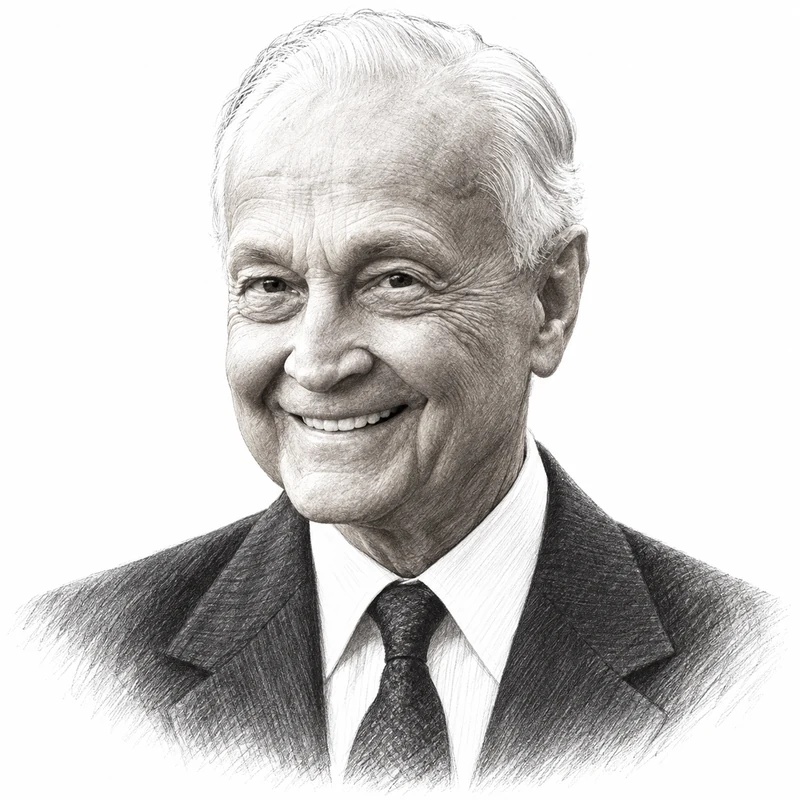
John Templeton was born in Winchester, Tennessee, on 29 November 1912, the second son of Harvey Templeton, a small-town lawyer who at one point owned around six farms, and Vella Handly Templeton, an elder of the local Presbyterian church who had studied Latin, Greek and mathematics. His parents placed few restrictions on him, so that as a boy he sold vegetables from his mother's garden and resold fireworks at a profit, and when his high school turned out not to teach the calculus he needed in order to apply to Yale, he persuaded the principal to let him set up and teach the course himself.
He arrived at Yale in 1930, but the Depression soon caught up with the family, and at the start of his second year his father told him that he could no longer contribute anything towards his education. John Templeton paid his way through the rest of the course with scholarships, part-time jobs and winnings from small-stakes poker, a game at which he became skilled and which, by his own account, he never played again. "At first this seemed like a tragedy, but now, looking back, it was the best thing that could have happened," he said many years later. He graduated in 1934 near the top of his class and as president of the Yale chapter of Phi Beta Kappa, and went on as a Rhodes Scholar to Balliol College, Oxford, where he took a law degree in 1936.
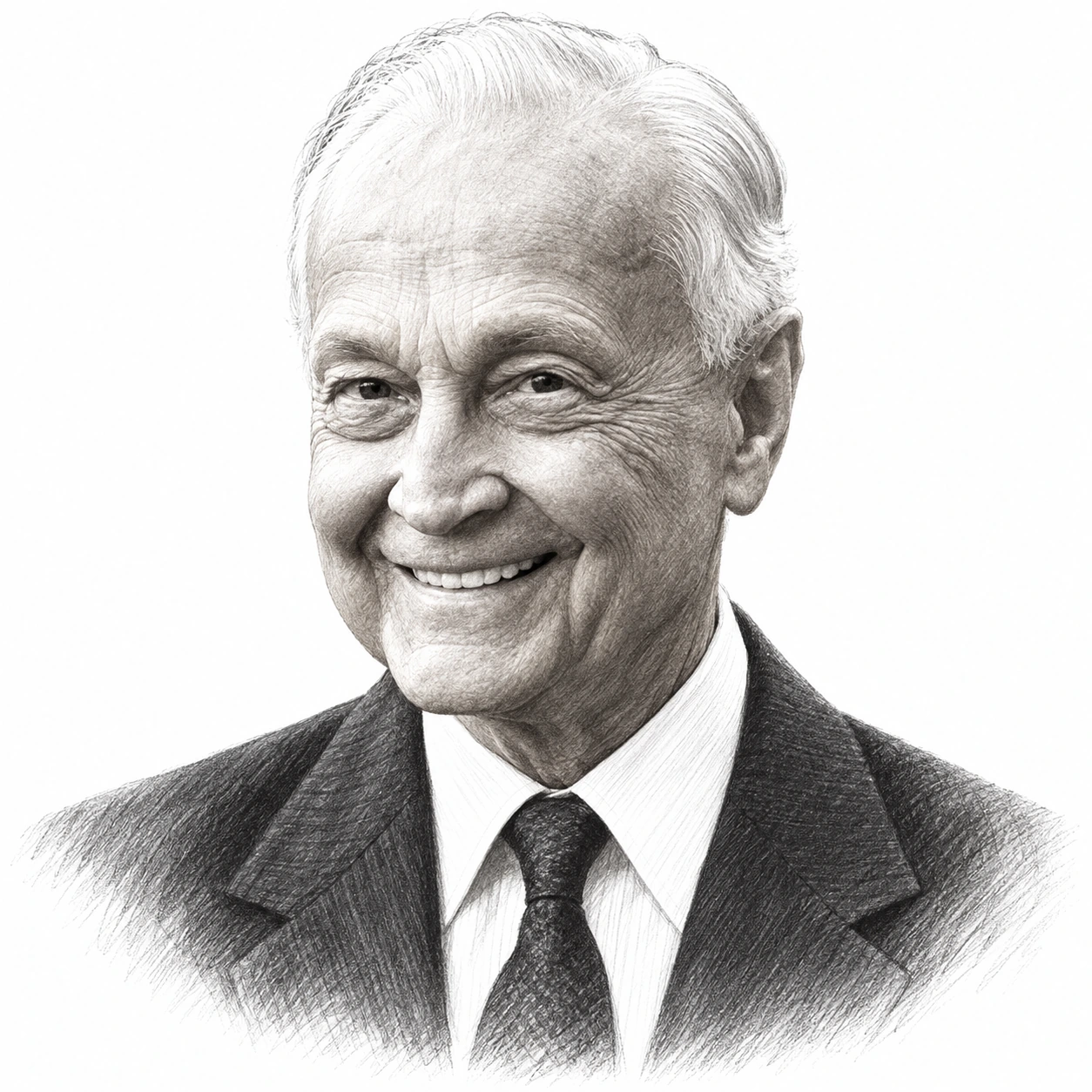
It was what he did next that set the direction of his career, because instead of going straight to work he spent the months after Oxford travelling around the world on a small budget, and the John Templeton Foundation traces his interest in opportunities outside the United States to this journey. He returned to America in May 1937, joined Fenner & Beane, a small investment firm in New York, and married Judith Folk the same year. The young couple resolved to save fifty cents of every dollar they earned and furnished a five-room flat for $25 by bidding at auctions.
From 1937 to 1940 John Templeton was vice-president of the National Geophysical Company, an oil exploration business in Dallas, and it was there that he made his best-known investment. In September 1939, as war began in Europe and American share prices stood at depressed levels, he borrowed $10,000 from his former boss at Fenner & Beane and instructed his broker to purchase $100 worth of every stock on the New York Stock Exchange trading at $1 a share or less. That came to 104 companies, 34 of which were already in bankruptcy, and his reasoning was that wartime demand would revive even weak businesses, whereas the market was pricing many of them as though they would disappear.
The outcome was that just four of the 104 turned out to be worthless, and when he sold the portfolio around four years later the $10,000 had grown to roughly $40,000. However, the story is often told without its risks, because he had purchased on borrowed money, a third of the companies were bankrupt when he purchased them, and the Dow was scarcely higher in September 1943 than in September 1939, so that the gain came from the recovery of individual distressed shares rather than from a rising market, and had his lender wanted the money back in 1940 or 1941 the result could have been very different.
In 1940 John Templeton sold his stake in National Geophysical and used the proceeds to purchase a small investment counselling firm in New York, which became Templeton, Dobbrow & Vance and, over time, the Templeton family of funds. The years that followed were hard ones at home, because his wife Judith died in 1951 and his mother within six months of her, leaving him with three young children, and he married again in 1958, to Irene Reynolds Butler.
Templeton Growth Fund, the vehicle on which his reputation rests, was launched on 29 November 1954, his 42nd birthday, with around $7m, and was incorporated in Canada rather than the United States. Its mandate was to invest anywhere in the world, which made it one of the first mutual funds through which North American savers could own shares in foreign companies.
The method behind the fund was set down most plainly in a list of maxims that William Proctor published in "The Templeton Touch", an authorised biography, in 1983. The best-known of them is the fourth: "The time of maximum pessimism is the best time to buy, and the time of maximum optimism is the best time to sell." The others explain how he put that into practice, because he argued that "too many investors focus on 'outlook' and 'trend'", so that "more profit is made by focusing on value", and that "if you search worldwide, you will find more bargains and better bargains than by studying only one nation". Putting this another way, the global mandate was not a view about which countries would grow fastest, but a way of widening the list of companies that might be cheap.
He added to these in 1993, in an article for World Monitor that Franklin Templeton still reprints as his sixteen rules for investment success. The first rule was to invest for "maximum total real return", meaning "the return on invested dollars after taxes and after inflation", and under the heading of learning from mistakes Mr Templeton wrote that the investor who says "'This time is different,' when in fact it's virtually a repeat of an earlier situation, has uttered among the four most costly words in the annals of investing." The line is usually quoted as "the four most dangerous words", a version newspapers were attributing to him by March 1993, although the earliest printed form of the saying is not his.
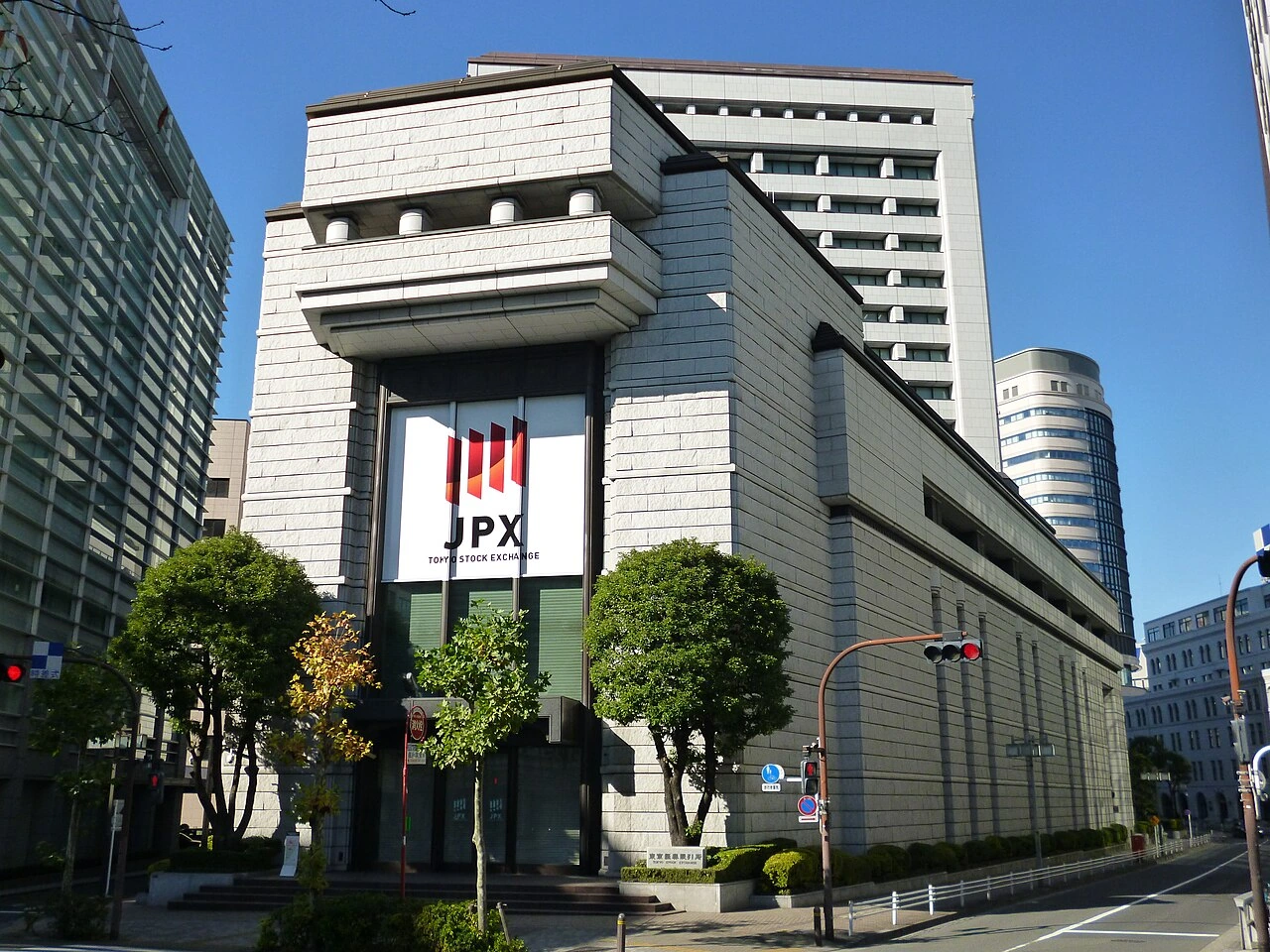
Japan was the clearest example of the method at work, because Templeton Growth Fund began purchasing Japanese shares in the 1960s, when few American fund managers paid them any attention, and by around 1970, as Mr Templeton told the Christian Science Monitor two decades later, half of his assets were in Japan "because that's where the bargains were". However, he was just as willing to leave, so that by the end of 1986 the Templeton World Fund had about 1% of its assets in Japan against roughly 50% a few years earlier, and Martin Flanagan, who later ran Franklin Templeton, recalled that in the late 1980s he refused to go back into a market trading at more than 50 times earnings. The Japanese market peaked at the end of 1989 and then fell for more than a decade, which meant that leaving early cost him far less than staying would have done.
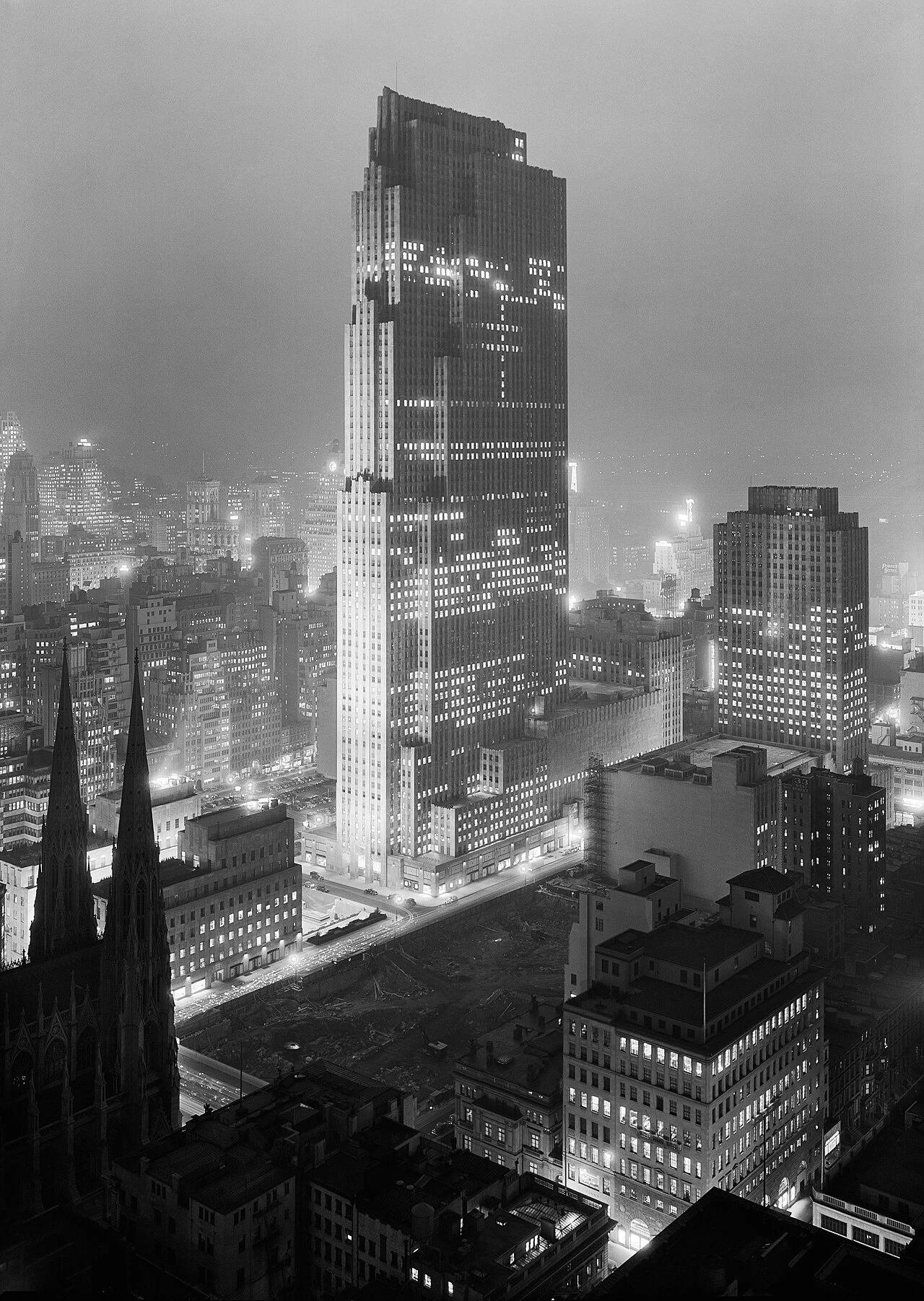
In the late 1960s John Templeton left New York for Lyford Cay, near Nassau in the Bahamas, and gave up his American citizenship to become a naturalised British citizen. Accounts differ on the exact year of the renunciation, and the move has often been described as a tax decision, which he denied, saying that his clients' results were "far better here than when I had my office in 30 Rockefeller Plaza" because distance from Wall Street made it easier to think differently from everyone else. By 1981 he was managing $1.6bn in mutual funds for around 132,000 shareholders, with Templeton Growth Fund itself at $600m, and by 1990 the organisation ran about $18bn from offices in eight countries.
He was open about the limits of the method, telling the Christian Science Monitor in 1981 that he made a mistake on about one in three of his choices, that the fund held a share for around five years on average, and that his philosophy was "simple minded", which is to say that it depended on patience and a willingness to be unpopular rather than on any special insight into economies.
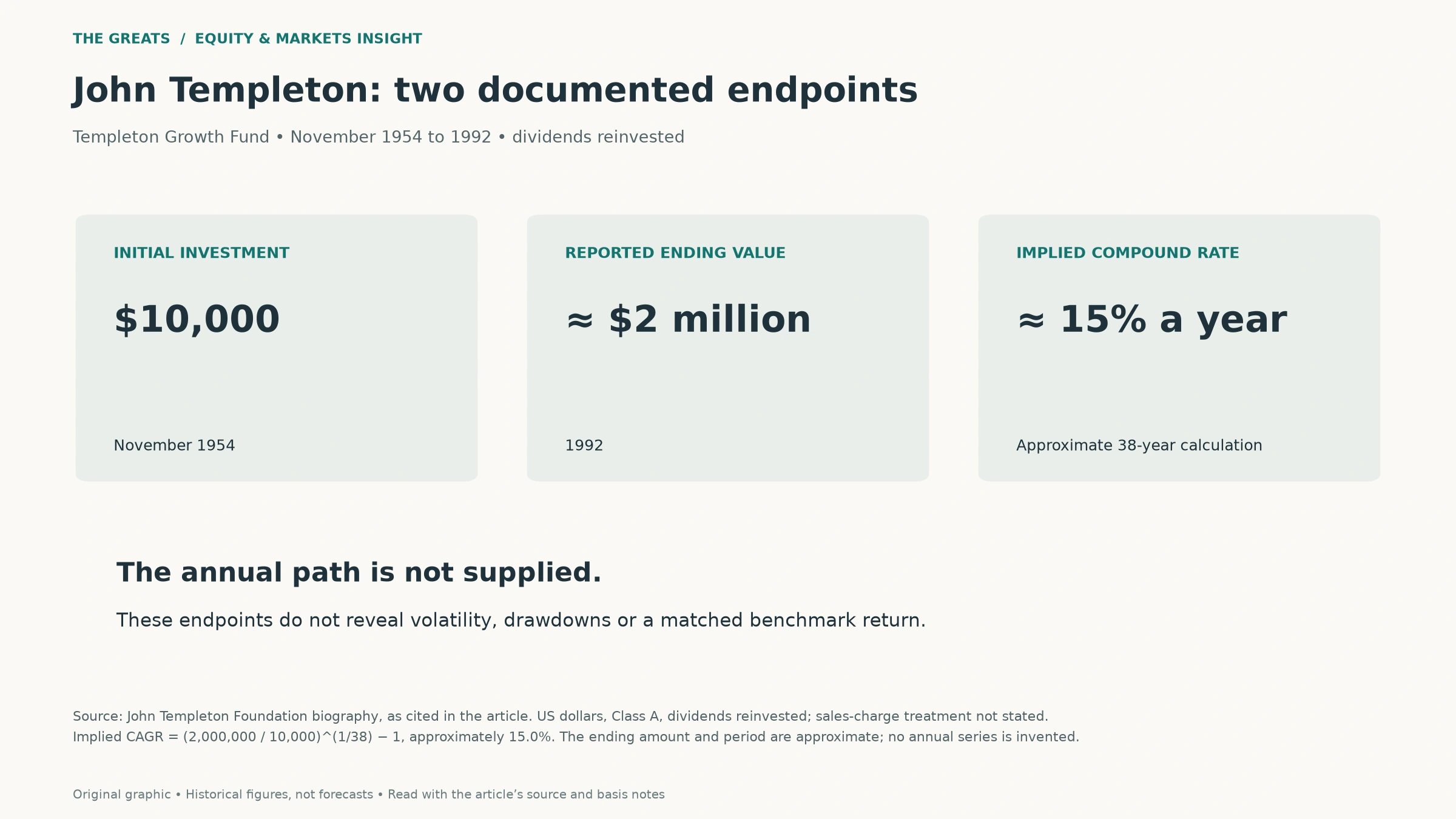
The record that resulted is usually summarised in a single illustration published by the John Templeton Foundation: $10,000 placed in the Class A shares of Templeton Growth Fund at launch in 1954, with dividends reinvested, would have grown to around $2m by 1992, when he sold the business. Over 38 years that works out at a compound rate of roughly 15% a year, and Franklin Templeton's own account at the time of his death put the figure at around 14.5%. The illustration does not say whether the initial sales charge, which was 8.5% on Templeton funds in the 1980s, has been deducted, and it does not show the path between the two endpoints or how the fund fared against a world index in any single year. It is a record of the past and not a forecast, and it is John Templeton's record only up to 1992, since the fund has now been run by other managers for longer than he ran it himself.
From the early 1970s onwards a growing share of his attention went elsewhere, because in 1972 he established the Templeton Prize for progress in religion, first awarded in 1973 to Mother Teresa, and insisted that its cash value should always exceed that of the Nobel prizes, so that it began at $85,000 and is now £1.1m. He published "The Humble Approach" in 1981 and set up the John Templeton Foundation in 1987 under the motto "How little we know, how eager to learn", and in the same year Queen Elizabeth II made him a Knight Bachelor for his philanthropy.
The business was sold on 31 July 1992, when Franklin Resources of California agreed to purchase Templeton, Galbraith & Hansberger, which by then managed $21.3bn across 78 funds, for $913m. John Templeton's own shares in the firm were valued at around $440m, a figure that some obituaries later mistook for the price of the whole business, and much of the proceeds went to his foundations. He was 79 and retired from managing money, although the funds kept his name, so that anything Templeton Growth Fund has done since belongs to his successors, and Franklin Templeton's September 2026 factsheet, which gives the Class A shares a compound return of 11.25% a year since 1954 before sales charges, blends his 38 years with 34 years of other managers.
He had not, however, finished investing on his own account. In early 2000, at the age of 87, he sold short a basket of around 84 Nasdaq technology companies whose shares had trebled from their flotation price, putting about $2.2m into each position, or roughly $185m in all, and timing each sale for the days before the lock-up period expired and insiders were first allowed to sell. According to the account given by his great-niece Lauren Templeton, the positions were closed for a profit of more than $90m, although this was a trade in his personal portfolio rather than in a fund, and the figures rest on that family account rather than on any published statement.
Irene Templeton died in 1993 and his daughter Anne in 2004. In 1999 Money magazine called him "arguably the greatest global stock picker of the century". Sir John Templeton died of pneumonia at Doctors Hospital in Nassau on 8 July 2008, aged 95, and was survived by his sons John and Christopher, a stepdaughter, three grandchildren and three great-grandchildren, while the foundation he left behind then had an endowment of around $1.5bn and was giving away about $70m a year.
The record
| Measure | Period | Figure | Basis and source |
|---|---|---|---|
| Growth of $10,000, Templeton Growth Fund Class A, dividends reinvested | Nov 1954 to 1992 | around $2m | John Templeton Foundation biography; sales-charge treatment not stated |
| Implied compound annual return from the above | 1954 to 1992 (38 years) | roughly 15% a year | Arithmetic from the Foundation's two endpoints; Franklin Templeton Canada's chief executive gave "about 14.5%" in July 2008 |
| Fund assets | 1954 | around $7m | Christian Science Monitor, July 1981 |
| Fund assets | 1981 | around $600m | Christian Science Monitor, July 1981 |
| Templeton funds' assets under management at sale | June 1992 | $21.3bn across 78 funds | Deseret News report of the Franklin agreement, 31 July 1992 |
| Templeton Growth Fund Class A, average annual total return since inception, before sales charge | 29 Nov 1954 to 30 Sep 2026 | 11.25% a year | Franklin Templeton fund factsheet; includes 34 years under successor managers |
The first two rows are the only figures that describe John Templeton's own management of Templeton Growth Fund, and both come from a single growth-of-$10,000 illustration in US dollars with dividends reinvested, from which no annual series, benchmark comparison or maximum drawdown can be recovered. The asset figures show how large the fund and the firm became, which is not the same thing as performance. The last row is the whole life of the fund to date and should not be read as his record, and none of these compound rates is a forecast.
Life in dates
- 1912Born in Winchester, Tennessee, on 29 November.
- 1930Enters Yale; in 1931 his father tells him he can no longer pay towards his education.
- 1934Graduates from Yale and goes to Balliol College, Oxford, as a Rhodes Scholar.
- 1936Takes his Oxford law degree and travels around the world.
- 1937Joins Fenner & Beane in New York; marries Judith Folk; becomes vice-president of National Geophysical Company in Dallas.
- 1939Purchases $100 of each of 104 shares trading at $1 or less with $10,000 of borrowed money.
- 1940Purchases a small New York investment counselling firm, which becomes Templeton, Dobbrow & Vance.
- 1951His wife Judith dies; his mother dies within six months of her.
- 1954Templeton Growth Fund launched on 29 November.
- 1956Co-founds Templeton Damroth, a technology fund; sells his stake in 1962.
- 1958Marries Irene Reynolds Butler.
- 1960sBuilds a large holding in Japanese shares, which reaches around half of the fund's assets by about 1970.
- Late 1960sMoves to Lyford Cay, Nassau, and becomes a naturalised British citizen.
- 1972Establishes the Templeton Prize; first awarded to Mother Teresa in 1973.
- 1981Publishes "The Humble Approach".
- 1983His investment maxims published in William Proctor's "The Templeton Touch".
- 1987Sets up the John Templeton Foundation; knighted by Queen Elizabeth II.
- 1992Franklin Resources agrees to purchase Templeton, Galbraith & Hansberger for $913m on 31 July; he retires from managing money.
- 1993His sixteen rules for investment success appear in World Monitor; Irene Templeton dies.
- 2000Sells short a basket of Nasdaq technology shares ahead of lock-up expiries.
- 2008Dies in Nassau on 8 July, aged 95.
Sources
- John Templeton Foundation: Sir John Templeton: birth, Yale and Oxford, the 1939 purchase (104 companies, 34 bankrupt, four worthless), the 1954 fund, the $10,000-to-$2m illustration, Bahamas and British citizenship, Templeton Prize, Foundation, knighthood, Money magazine, death.
- John Templeton Foundation: The purpose of the John Templeton Foundation: childhood enterprise, the calculus course, the 1936 journey, the deaths of his mother and first wife, the 1992 sale.
- Sir John Templeton, "16 Rules for Investment Success" (1993), Franklin Templeton reprint: maximum total real return, "this time is different", bull and bear markets, searching worldwide.
- Advisor Perspectives: John Templeton's 22 maxims, from William Proctor's "The Templeton Touch" (1983): maximum pessimism and the other maxims quoted.
- Christian Science Monitor, 2 July 1981: "Wall Street whiz-cum-philanthropist": father unable to pay for Yale, return in May 1937, saving half of income, $25 furniture, Lyford Cay, fund assets in 1954 and 1981, prize values.
- Christian Science Monitor, 23 February 1981: "Disciple of basic stock values": one-in-three mistakes, five-year holding period, "simple minded".
- Christian Science Monitor, 10 December 1986: World Fund's Japan weighting cut to about 1% from about 50%.
- Christian Science Monitor, 12 March 1990: "Templeton's Advice: Buy For Long Haul": half of assets in Japan around 1970, $18bn under management, offices in eight countries.
- Deseret News, 31 July 1992: "Franklin Resources Inc. to buy Templeton empire": $913m price, $21.3bn across 78 funds, Templeton aged 79.
- Reference for Business: Franklin Resources, Inc. history: Templeton's shares valued at $440m, adviser role after the sale.
- Institutional Investor, 17 July 2008: "Legendary Investor Dies": Japan exit and refusal to return at over 50 times earnings (Martin Flanagan), $913m sale and retirement.
- Tennessee Encyclopedia: John Marks Templeton: parents, Fenner and Beane, National Geophysical Company 1937–40, Templeton Dobbrow and Vance 1940.
- Financial Advisor magazine: "Making Templeton" and page 3: family background, poker at Yale, the "best thing that could have happened" quotation (citing "Investing the Templeton Way"), 14.5% a year 1954–92, the 2000 short ($185m, $90m profit, per Lauren Templeton).
- Redwheel: "Canary in the coal mine": the 2000 short in detail ($2.2m a position, lock-up timing, 95% falls), citing "Investing the Templeton Way" and Forbes, 28 May 2001.
- Philanthropy Roundtable: "Sir John M. Templeton, RIP": "30 Rockefeller Plaza" quotation, the Kia, the fax machine, Foundation endowment and grants, Princeton Theological Seminary.
- Philanthropy Roundtable Hall of Fame: John Templeton: 1968 move to the Bahamas, first Templeton Prize to Mother Teresa, Prince Philip.
- Investment Executive, 8 July 2008: "Sir John Templeton dies in Bahamas": Templeton Damroth 1956–62, Franklin Templeton tribute.
- Advisor.ca, 8 July 2008: "Sir John Templeton passes away": "about 14.5%" a year (Don Reed, Franklin Templeton Canada), $40,000 outcome of the 1939 purchase, maximum pessimism quotation.
- Mail & Guardian (Sapa-AP), 9 July 2008: "Investing pioneer dies in Bahamas": death at Doctors Hospital, Nassau, of pneumonia on 8 July 2008; survivors.
- Christian Century, August 2008: Foundation motto and endowment, knighthood, death at Doctors Hospital.
- Templeton Growth Fund, Inc. factsheet, 30 September 2026: inception date 29 November 1954; since-inception returns by share class.
- Barry Popik: "The four most expensive words": earliest printed attributions of the "this time it's different" saying.
- 24/7 Wall St, 3 October 2026: $10,000 borrowed from his former boss at Fenner & Beane; the Dow in September 1943 against September 1939 (secondary).
- Wikipedia: John Templeton: marriages and their dates, children, Judith Folk's death, Irene Templeton's death in 1993, Anne's death in 2004 (citing the New York Times obituary of 9 July 2008, which could not be fetched directly).